

Image: Corneal Topography of an eye with Keratoconus
What is Keratoconus?
Keratoconus can cause difficulties achieving clear, comfortable vision with glasses or standard contact lenses. As the shape of the cornea becomes increasingly irregular, vision may remain blurred or distorted even when the spectacle prescription is correct.
Specialty contact lenses can provide significantly better vision for many people with keratoconus by creating a more regular optical surface over the cornea.
At Visionworks Optometrists, we provide keratoconus contact lens assessment and fitting in Sydney, with lens selection tailored to the shape of the cornea, visual requirements and individual comfort.
What is keratoconus?
Keratoconus is a condition in which the normally regular shape of the cornea becomes progressively thinner and more irregular. Rather than maintaining a relatively smooth curved surface, the cornea can develop a more cone-like shape.
This irregularity can cause:
Blurred or distorted vision
Increasing or irregular astigmatism
Frequent changes in spectacle prescription
Glare, halos or ghosting around lights
Reduced vision that cannot be fully corrected with glasses
The severity and progression of keratoconus varies considerably between individuals, which is why management and visual correction need to be personalised.
Why are contact lenses used for keratoconus?
Glasses correct refractive error but cannot eliminate all of the optical distortion produced by an irregular corneal surface.
Specialty contact lenses can create a more regular optical surface in front of the cornea. This can substantially improve the quality of vision in people whose keratoconus can no longer be adequately corrected with spectacles.
Importantly, contact lenses are primarily used to improve vision. They do not treat the underlying progression of keratoconus.
If there is evidence that keratoconus is progressing, further assessment and treatments such as corneal cross-linking may need to be considered in conjunction with an ophthalmologist.
What contact lenses are available for keratoconus?
There is no single best contact lens for every person with keratoconus. The most appropriate design depends on the degree and location of corneal irregularity, prescription, ocular surface, previous lens experience and individual visual requirements.
Rigid Gas Permeable (RGP) Contact Lenses
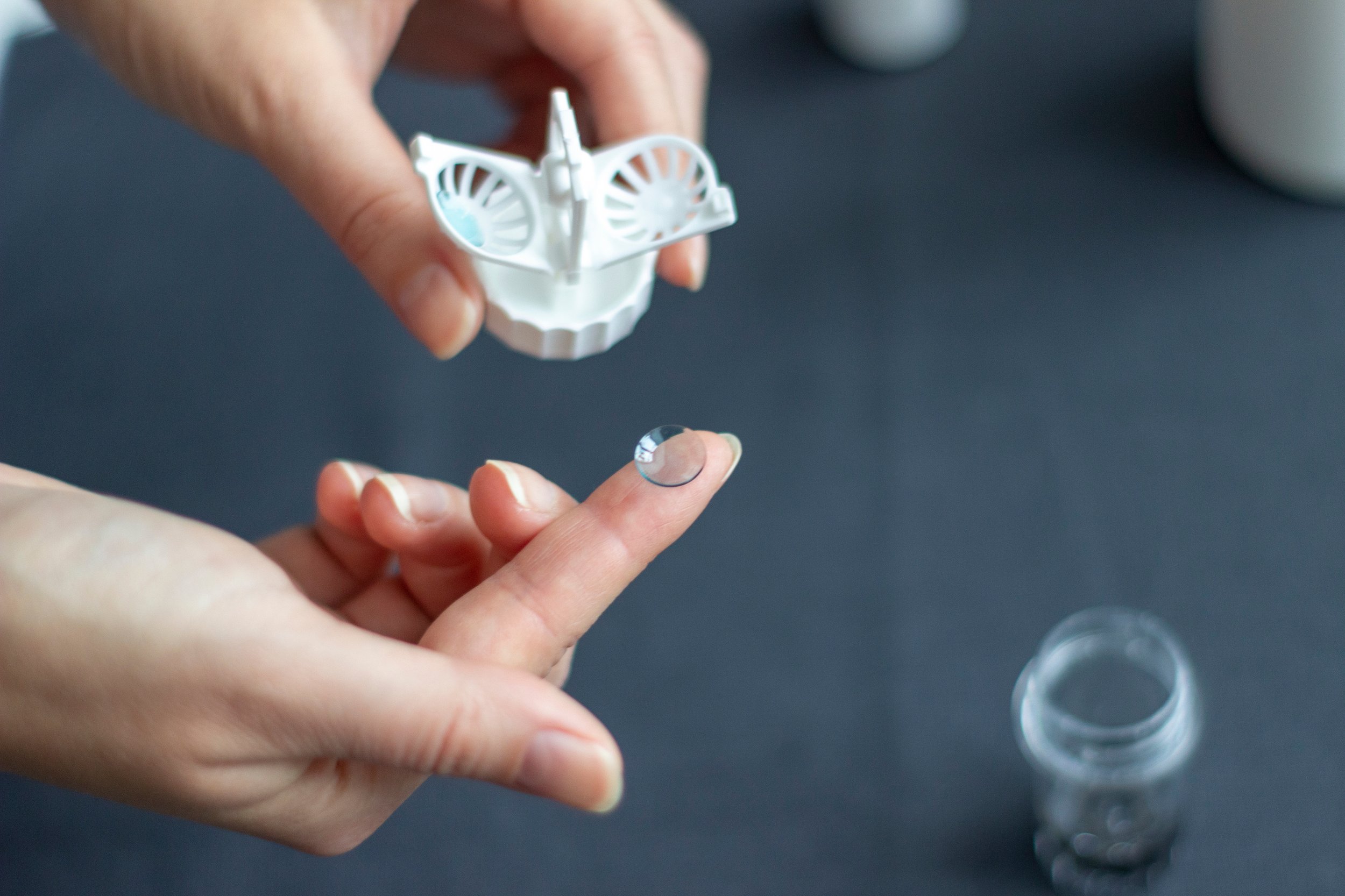
RGP lenses are small rigid lenses that sit over the cornea. The tear layer between the lens and the irregular corneal surface helps create a more regular optical system.
They can provide excellent visual acuity and remain an important option for many people with mild to moderate keratoconus.
Scleral Contact Lenses
Scleral lenses are larger rigid lenses that vault over the cornea and rest on the white part of the eye, known as the sclera.
The space between the lens and cornea is filled with preservative-free saline before insertion. This creates a fluid reservoir over the corneal surface.
Scleral lenses can be particularly useful where corneal irregularity is more significant, where conventional RGP lenses are unstable or uncomfortable, or where the ocular surface requires additional consideration.
Other Specialty Contact Lens Options
Depending on the individual eye, other designs may also be considered, including specialised keratoconus RGP designs, hybrid lenses and other customised lens systems.
The aim is not simply to select the most complex lens. It is to find the simplest lens design that provides an appropriate balance of vision, comfort, corneal health and stability.
What happens during a keratoconus contact lens fitting?
A keratoconus contact lens fitting involves considerably more than measuring a spectacle prescription.
Your assessment may include examination of the cornea, measurement of your prescription and visual acuity, assessment of the ocular surface and detailed evaluation of corneal shape using corneal topography or tomography, where appropriate.
Diagnostic contact lenses can then be placed on the eye to assess their relationship with the cornea, movement, stability, comfort and visual performance.
Once an appropriate lens design has been identified, lenses can be ordered to the required parameters.
Follow-up appointments are an important part of the process. The fit and health of the eye are reassessed after the lenses have been worn, and modifications can be made where necessary.
RGP or scleral lenses for keratoconus?
Both can provide excellent vision, but they behave quite differently on the eye.
Traditional corneal RGP lenses are smaller and generally simpler to handle. For an appropriate corneal shape, they can provide excellent optics with relatively straightforward lens care.
Scleral lenses are considerably larger and vault the cornea rather than primarily resting upon it. This can provide greater stability and comfort for some patients, particularly with more irregular corneas.
However, scleral lenses are not automatically the better option simply because they are newer or larger. Lens selection should be based on the individual eye and the clinical objectives of the fitting.
Can keratoconus contact lenses give me normal vision?
The amount of improvement possible depends on the severity of the keratoconus and whether there are other factors affecting vision, such as corneal scarring.
Many people achieve substantially clearer vision with appropriately fitted specialty contact lenses than they can achieve with spectacles.
The purpose of the initial assessment is therefore not only to determine which lens may fit the eye, but also to establish the level and quality of vision that can realistically be achieved.
Does wearing contact lenses stop keratoconus progressing?
No. Contact lenses are primarily a method of vision correction.
Keratoconus progression and vision correction should be considered separately.
Where progression is suspected, particularly in younger patients, appropriate monitoring is important. Corneal cross-linking may be recommended by an ophthalmologist to reduce the risk of further progression.
Contact lenses can subsequently be used to optimise vision where required.
Keratoconus Contact Lens Fitting in Sydney
Successful keratoconus contact lens fitting requires careful assessment of both the optical correction and the interaction between the lens and the eye.
At Visionworks Optometrists, we assess patients requiring specialty contact lens correction and can consider RGP, scleral and other lens designs according to the individual characteristics of the eye.
If you have been diagnosed with keratoconus, are struggling to achieve satisfactory vision with glasses, or are having difficulty with your existing contact lenses, a specialty contact lens assessment can help determine the options available to you.
Contact Visionworks Optometrists to arrange a keratoconus contact lens assessment in Sydney.